
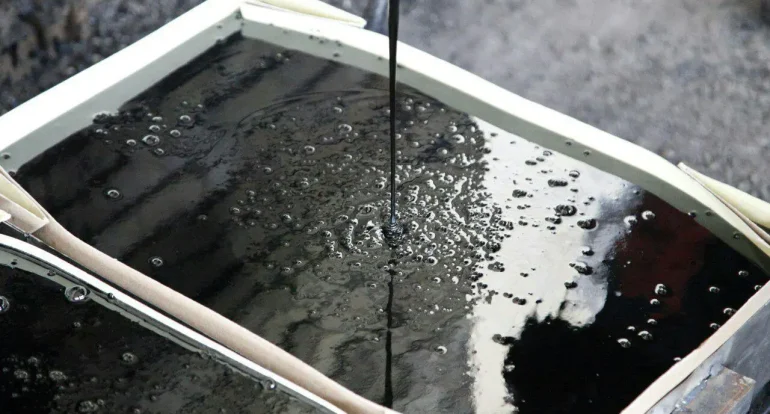
OXIDIZED BITUMEN (BLOWN ASPHALT)
Oxidized Bitumen, also known as Blown Asphalt, is exported in various grades including Oxidized Bitumen 115/15, Blown Bitumen 90/40, 75/25, 85/25, 90/15, 105/35, 150/5, and 95/25, with additional grades produced according to order. Raha Oil is a dynamic and multi-faceted company actively involved in the manufacturing, procurement, distribution, and export of various grades of Blown Asphalt, with a dedicated division focused on the oxidization of bitumen to serve the diverse needs of customers worldwide.
Raha Oil has a long history of supplying Blown Asphalt to bitumen factories, asphalt companies, roof insulation companies, and membrane sheet manufacturers throughout the world. Oxidized Bitumen grades are suitable for sealing saw cuts and joints where minimal movement is expected, and their wide temperature range prevents bleeding in high-temperature applications.
Oxidized Bitumen, also known as Blown Asphalt, is exported in various grades including Oxidized Bitumen 115/15, Oxidized Bitumen 90/40, Oxidized Bitumen 75/25, Oxidized Bitumen 85/25, Oxidized Bitumen 90/15, Oxidized Bitumen 105/35, Oxidized Bitumen 150/5, and Oxidized Bitumen 95/25, with additional grades produced according to order.
APPLICATIONS OF OXIDIZED BITUMEN
Oxidized Bitumen has different applications across various industries. In the oil and gas sector, it is used as a coating material for pipelines and pipe joints. In the electrical industry, it serves as a sealant for wire coating. In the waterproofing industry, it is used to manufacture building roofing felts and as a key component in producing waterproofing roofing felt sheets.
Blown Asphalt is also used by bitumen and asphalt factories to produce different grades of bitumen and asphalt for road paving, and it is a key material in manufacturing sound dampening layers for sound insulation applications.
PRODUCTION PROCESS & OPERATING CONDITIONS
Blowing is performed from the bottom of the blowing tower. The reaction between bitumen and air is exothermic, and if excessive heat builds up during the process, it is controlled through water injection. Air admixture and blowing volume are the two key variables in the process.
In standard production, Bitumen 60/70 is typically used as the base material for blowing. For harder grades such as 90/15 or 85/25, distilled used oil or crude oil is injected at 20–25% by volume to prevent excessive fragility in the finished product. Increasing heating temperature, air injection rate, and tower pressure all accelerate the reaction.
The optimal operating temperature is 265–270°C. Air injection is carried out at 190–232°C, and the blowing tower is filled to a maximum of 70% capacity to accommodate volume expansion during the reaction. The blowing endpoint is determined through sampling and testing of the bitumen properties. Once the desired properties are reached, the product is cooled to 150–165°C before loading and packing.
⚠️ Safety Note: Operating temperature must not exceed 288°C, as the reaction becomes significantly more intense and uncontrollable beyond this point, creating a risk of tower explosion. Extended holding time in the tower under any condition should be avoided — the product should be transferred to drums or tankers promptly once ready. Low liquid levels in the tower increase the risk of air accumulation in empty spaces, which can lead to ignition.
HOW OXIDIZED BITUMEN IS MANUFACTURED
- Bitumen is heated to 265–270°C.
- Melted bitumen is transferred to the blowing towers.
- Air is blown through the bitumen.
- Melted bitumen is cooled with water.
- The finished product is packed.
Blown Asphalt production follows either a continuous or discontinuous blowing procedure, further refined through catalysis or anti-catalysis techniques. Catalysis involves adding chemical materials during the process to reduce blowing reaction time, offering several advantages: easier control over blowing conditions to produce different grades, simpler unit operation, and lower technology and investment costs. For these reasons, Raha Oil primarily uses the discontinuous production procedure.
STEP-BY-STEP PRODUCTION PROCESS
The production process begins with loose bitumen being shipped to the plant by tanker and transferred to the raw material storage tank, where a burner at the base of the tank heats the material for easier transfer. If the blowing towers are empty, hot bitumen can be loaded directly and the blowing operation can begin immediately.
Since bitumen volume increases during blowing, towers are filled to a maximum of 70% to prevent overflow. Air injection typically begins once the material reaches 190–230°C, entering from the top of the tower while bitumen is dispersed evenly through nozzles at the bottom, allowing oxidation to occur as light molecules, volatile gases, and steam are released from the top.
Blowing takes place within a temperature range of 215–290°C, with 265–270°C considered optimal. Heat is supplied by a burner at the base of the tower, and because the reaction is exothermic, temperature is carefully controlled through water injection, burner adjustment, or reduced air flow to prevent overheating.
The blowing endpoint is determined through sampling and testing until the bitumen reaches its specified properties. The product is then brought to a high temperature briefly to stabilize its final structure before being transferred to storage, packed, and prepared for sale.
Gases and steam released during the process pass through a condenser, where odorous, oily, and volatile components are separated and directed to wastewater treatment along with water. Remaining gases are routed to a furnace for combustion. Once the blowing tower cools to 150–160°C, the finished hard bitumen is ready for loading and packing. Due to the natural liquid height in the tower, the product can be transferred by gravity without requiring a pump. Packing takes place using multiple taps to fill drums and cartons simultaneously, minimizing cooling and hardening during the process.
KEY ADVANTAGES OF OXIDIZED BITUMEN
Durability: Maintains structural integrity over long service periods, even under continuous environmental exposure.
Flexibility: Adapts to movement and stress without cracking, making it suitable for sealing and joint applications.
Water Resistance: Provides a reliable barrier against moisture penetration in waterproofing and roofing applications.
Chemical Stability: Remains stable when exposed to a wide range of chemicals and environmental conditions.
Compared to standard paving grade bitumen, Blown Asphalt offers reduced temperature susceptibility, a more solid consistency at ambient temperatures, and a higher penetration index — making it better suited to industrial applications where dimensional stability matters more than flexibility under traffic loads.
INDUSTRIAL APPLICATIONS OF BLOWN ASPHALT
Blown Asphalt is used almost entirely for industrial applications such as roofing, flooring mastics, pipe coatings, and paints, and is specified according to both softening point and penetration test results.
- Bonding agent for roofing sheet membrane
- Hot-applied waterproofing layer
- Raw material for liquid bitumen coatings
- Production of bituminous paint and mastic
- Rust-proof pipe coatings
- Anti-slip layer compound in the piling industry
- Production of roofing felts and sound dampening felts
- Undercarriage sealant in the automotive industry, electric cable joint protection, and joint filling compound.
Available Oxidized Bitumen Grades
Click any grade to view full specifications
All grades are available ex-works Jebel Ali, UAE. Additional custom grades can be produced according to individual client specifications.
DIFFERENT TYPES OF PACKAGING
Packaging methods for Blown Asphalt depend on the required quantity, application, and storage conditions. Raha Oil offers the following common packaging options:
Drums and Pails: For smaller quantities, Blown Asphalt is supplied in steel drums (around 180 kg) or pails (around 20 kg), offering easy handling for retail or smaller-scale use. This packing method allows loading of approximately 20 tons in a 20ft container.
PP Bags: The most common packing option is a 25 kg PP bag, palletized and shrink-wrapped for secure transport. With this method, approximately 23.5 tons can be loaded per 20ft container.
Carton Box: A 25 kg carton box is another widely used packing option, allowing approximately 22 tons to be loaded per 20ft container.
The right packaging method depends on cost-effectiveness, ease of handling, and the specific requirements of each application. Proper packaging and handling are essential to preserving the quality and performance characteristics of Oxidized Bitumen throughout storage and transport.
Oxidized Bitumen Packaging Options
All packing options ship ex-works Jebel Ali, UAE.
GET OXIDIZED BITUMEN EXPORT QUOTE
Looking for a reliable Oxidized Bitumen Supplier in UAE?
RAHA Oil provides competitive FOB and CFR export prices for Blown Asphalt with worldwide shipment support from Jebel Ali ports.
- SGS Inspection Available
- Worldwide Export Support
Contact our export team today for updated prices and shipment schedules.


