
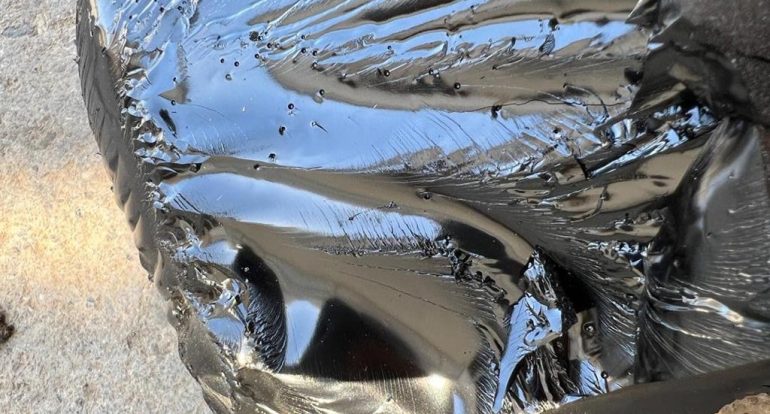
Description of Oxidized Bitumen 75/35
Oxidized Bitumen 75/35, also called Blown Asphalt 75/35 or Blown Bitumen 75/35, is the softest and most flexible grade in Raha Oil’s oxidized bitumen range. It is produced by blowing air through a soft penetration-grade bitumen at elevated temperature in a controlled oxidation unit. The process is stopped earlier than for harder grades, so the final product keeps a lower softening point and a higher penetration.
The result is a bitumen that is solid at room temperature but noticeably more pliable than grades such as 85/25 or 115/15. It melts more easily, wets surfaces well, and stays flexible in cooler conditions. These properties make it a practical choice for roofing, membranes and adhesive applications that need good workability rather than maximum hardness.
What Does 75/35 Mean?
The grade name refers to the midpoints of its two key specification ranges:
75 is the midpoint of the softening point range, 70–80 °C (Ring and Ball, ASTM D36).
35 is the midpoint of the penetration range, 30–40, in units of 0.1 mm at 25 °C (ASTM D5).
Compared with Oxidized Bitumen 85/35 , which has the same penetration, 75/35 softens about 10 °C earlier. Compared with Oxidized Bitumen 75/25 , which has the same softening point, it is softer and more flexible.
Like all air-blown grades, 75/35 has a much higher penetration index (PI) than road bitumen. Its consistency therefore changes less with temperature than that of paving-grade products.
Raha Oil – Supplier of Oxidized Bitumen 75/35
Raha Oil supplies Oxidized Bitumen 75/35 from Jebel Ali, Dubai, to roofing and waterproofing manufacturers, contractors and traders across the Middle East, Africa, and South and Southeast Asia. Each batch is tested against the technical data sheet below and shipped with a Certificate of Analysis (COA), MSDS, packing list and Certificate of Origin. For prices and availability, contact our sales team .
Applications of Oxidized Bitumen 75/35
The flexibility and easy melting of Oxidized Bitumen 75/35 suit it to applications where the bitumen must bend, penetrate or bond rather than carry heavy load:
Roofing felts and shingles: saturating and coating roofing felts and bituminous shingles.
Waterproofing membranes: a base bitumen for oxidized bitumen membranes and damp-proof courses.
Foundation and basement waterproofing: hot-applied coatings on below-ground concrete and masonry.
Adhesives: bonding insulation boards, roofing sheets and floor coverings.
Sound and vibration damping: bituminous pads and sheets for vehicles, appliances and buildings.
Protective coatings: bituminous paints and coatings for metal and concrete that are not exposed to high surface temperatures.
Which climate is it for? Because its softening point is 70–80 °C, 75/35 is best for moderate and cool climates and for covered or below-ground surfaces. Exposed roofs in hot regions such as the Gulf can reach surface temperatures close to this range. For those, a harder, higher-softening grade such as Oxidized Bitumen 85/25 or Oxidized Bitumen 105/35 is usually the safer choice.
Application Guidelines
Heat Oxidized Bitumen 75/35 gradually until it is fluid enough to pour or spread, without exceeding the maximum temperature given in the handling section. Thanks to its lower softening point, it reaches working consistency faster than harder grades. Apply it only to surfaces that are dry, clean and free of dust, oil, loose material and curing compounds. Priming concrete and masonry first with Bitumen Primer D41 improves adhesion.
Key Properties of Blown Asphalt 75/35
Flexible consistency: penetration of 30–40 gives good pliability and resistance to cracking under movement.
Easy melting and good workability: a softening point of 70–80 °C means lower working temperatures and faster melting.
Good low-temperature performance: stays flexible in cool weather where harder grades may become brittle.
Waterproof and moisture resistant: forms a continuous, impermeable film.
Excellent wetting and adhesion: penetrates porous surfaces and bonds well to felts, concrete and metal.
Stable during heating: loss on heating of 0.2 wt% max.
Need a different balance of hardness and heat resistance? Compare Oxidized Bitumen 75/25 , Oxidized Bitumen 85/40, or view all grades on our Oxidized Bitumen page .
Handling and Storage of Oxidized Bitumen 75/35
Storage conditions:
Because 75/35 has a lower softening point than harder grades, it is more sensitive to warm storage conditions. Keep it in a shaded, dry and well-ventilated warehouse, away from direct sunlight and heat sources.
Place bags, cartons and drums on pallets and limit stack height, especially in hot weather, so the lower layers do not soften, deform or stick together.
Keep the product sealed in its original packing until use to protect it from water, dust and contamination.
Melting and heating:
Bitumen conducts heat poorly, so the melting process should be controlled carefully.
Break the material into smaller pieces before loading the melting kettle, so heat spreads evenly and the kettle base and walls do not overheat.
Heat gradually and do not exceed 230 °C. 75/35 becomes fluid at a lower temperature than harder grades, so there is usually no need to approach this limit. Overheating can crack the bitumen and release flammable vapours, increasing the fire risk.
Do not allow a melted batch to solidify in the kettle and then reheat it from cold. This can create hot spots and pressurised vapour pockets.
Install temperature sensors close to the heating surface for accurate readings.
Keep hot bitumen away from water, which can cause violent foaming.
Minimise heating time. Prolonged or repeated heating continues to harden the bitumen and can take it out of specification.
Health and Safety
Protective equipment: wear heat-resistant gloves, safety goggles or a face shield, long-sleeved protective clothing and safety boots when working with hot bitumen.
Ventilation: work in well-ventilated areas and avoid inhaling fumes. Hydrogen sulphide (H₂S) may build up in tanks and enclosed spaces where hot bitumen is stored.
Burns: if hot bitumen touches the skin, cool the area under cold running water for at least 15 minutes. Do not remove the bitumen from the skin. Seek medical attention.
Cleaning: use an approved bitumen cleaner away from heat and flames. Do not use gasoline (petrol).
Fire: use foam, dry chemical powder or CO₂ extinguishers. Never spray water onto hot or burning bitumen.
For full safety details, request the MSDS for Oxidized Bitumen 75/35 from our sales team .
Packing Options for Oxidized Bitumen 75/35
Raha Oil ships Oxidized Bitumen 75/35 in four export packing types. Because this grade is softer than other oxidized grades, choosing the right packing matters more, especially for hot destinations and long storage periods. Bags can be palletised, with 40 bags per pallet, or loaded loose in 20ft containers.
Kraft Paper Bags – 20 kg and 50 kg
Multi-layer Kraft paper bags with a silicone-coated lining that stops the bitumen from sticking. This is the most economical option and is well suited to moderate climates and short storage times. The paper is stripped off before melting.
Polyamide Bags – 20 kg and 50 kg
Hot-filled, heat-resistant polyamide bags, cooled quickly in water after filling. The tough film keeps out moisture and contamination and helps the bags hold their shape during handling.
Carton Boxes – 25 kg
The bitumen is cast into lined carton moulds and sets into solid blocks. Cartons give better shape retention than bags in warm conditions, stack neatly and are easy to handle on site. This premium option is recommended for hotter destinations.
Steel Drums – 150 kg, 180 kg and 200 kg
Sealed steel drums give the highest protection against heat deformation, moisture and contamination. They are the best choice for long sea voyages, hot climates and extended storage. Drums per container depend on the drum size selected.
Not sure which packing suits your project? Read more about our bitumen packaging options or ask our sales team for a recommendation.
Frequently Asked Questions - FAQ
Oxidized Bitumen 75/35, also called Blown Asphalt 75/35, is a soft, flexible grade of air-blown bitumen. It has a softening point of 70–80 °C and a penetration of 30–40, which makes it easy to melt and well suited to roofing, membranes, adhesives and waterproofing.
75 is the midpoint of the softening point range (70–80 °C, ASTM D36), and 35 is the midpoint of the penetration range (30–40 × 0.1 mm at 25 °C, ASTM D5).
It is mainly used for saturating and coating roofing felts and shingles, making oxidized bitumen membranes and damp-proof courses, waterproofing foundations and basements, bonding insulation and roofing sheets, sound-damping products, and protective bituminous coatings.
It is best for moderate and cool climates, and for covered or below-ground surfaces. Exposed roofs in very hot regions can reach temperatures close to its softening point, so a harder grade such as 85/25 or 105/35 is usually recommended there.
75/35 and 85/35 have the same penetration, but 75/35 softens about 10 °C earlier. 75/35 and 75/25 have the same softening point, but 75/35 is softer and more flexible. Of the three, 75/35 is the easiest to melt and the most pliable.
Heat it gradually until it is fluid enough to apply, and never above 230 °C. Because of its lower softening point, 75/35 reaches working consistency at lower temperatures than harder oxidized grades.
Raha Oil offers 20 kg and 50 kg Kraft paper and polyamide bags, 25 kg carton boxes, and 150 kg, 180 kg and 200 kg steel drums. For hot destinations or long storage, carton boxes or steel drums are recommended because they hold their shape better than bags.
Raha Oil ships from Jebel Ali, Dubai, UAE, to the Middle East, Africa, and South and Southeast Asia. Every shipment includes a Certificate of Analysis (COA), MSDS, packing list and Certificate of Origin.
| Property | Test Method | Unit | Specification |
|---|---|---|---|
| Specific Gravity @ 25/25 °C | ASTM D70 | — | 1.05 approx. |
| Penetration @ 25 °C100 g, 5 s | ASTM D5 | 0.1 mm | 30 – 40 |
| Softening PointRing & Ball | ASTM D36 | °C | 70 – 80 |
| Loss on Heating | ASTM D6 | wt % | 0.2 max |
| Flash PointCleveland Open Cup | ASTM D92 | °C | 250 min |
| Solubility in CS2 | ASTM D4 | wt % | 99.5 min |
| Spot Test | AASHTO T102 | — | Negative |
Why Choose Raha Oil for Oxidized Bitumen 75/35
Raha Oil manufactures Oxidized Bitumen 75/35 from Dubai, UAE, with production and testing following ASTM standards. Quality is verified through internal testing before every shipment, with full documentation — including TDS, COA, and MSDS — provided on request.
With flexible packing — from 20 kg Kraft bags to 200 kg steel drums, including palletized options — and an established export track record across the GCC, Africa, and Asia, Raha Oil supports both trial orders and large-scale industrial supply requirements for this specialized hard grade.
Get Oxidized Bitumen Export Quote
Looking for a reliable Oxidized Bitumen supplier in UAE?
RAHA Oil provides competitive FOB and CFR export prices for Blown Asphalt with worldwide shipment support from Jebel Ali ports.
- SGS Inspection Available
- Worldwide Export Support
Contact our export team today for updated prices and shipment schedules.


