
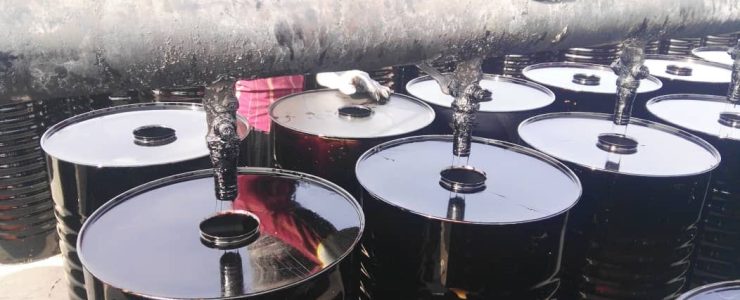
WHAT IS BITUMEN PENETRATION GRADE
Bitumen Penetration Grade is classified by hardness, using a standardized needle penetration test. Grades typically range from 15 to 450, with 25 to 200 being the most common range for road construction.
The grading principle is simple: the softer the bitumen, the deeper a standard needle penetrates into it under controlled conditions. This Penetration grade Bitumen depth is measured in tenths of a millimeter (0.1 mm). For example, Bitumen 60/70 means the needle penetrates between 60 and 70 tenths of a millimeter into the sample — not decimeters, a common misconception.
Bitumen with high penetration numbers is softer and used in cold climates, while bitumen with low penetration numbers is harder and used in warm climates. This penetration depth correlates empirically with real-world binder performance, making it one of the most widely used classification methods in the industry.
The most common Penetration grade Bitumen supplied by RAHA Oil are 60/70, 80/100, 85/100, 40/50, and 30/40. Lower penetration grades are typically used in warmer regions, while higher penetration grades suit colder climates. Among these, 60/70 is the most widely used grade across global road construction markets.
Penetration grade Bitumen is refinery-produced from vacuum distillation of crude oil and is available at different viscosities depending on grade.
Penetration Grading: Advantages & Disadvantages
A balanced look at the standard needle penetration test method
| ✓ Advantages | ! Disadvantages |
|---|---|
| The test is quick, inexpensive, and can easily be performed in the field. | Temperature susceptibility cannot be determined from a single test at 25°C alone. |
| Provides a reasonable correlation with binder performance in typical pavement conditions, since testing is done at 25°C — close to average pavement temperature. | Shear rate during the test is variable, and since bitumen behaves as a non-Newtonian fluid at 25°C, this can affect result consistency. |
| Used industry-wide for over a century, giving it a large base of comparative historical data. | Does not provide information for establishing mixing or compaction temperatures, and is empirical rather than a fundamental engineering measurement such as viscosity. |
USAGE OF BITUMEN PENETRATION GRADE
Bitumen penetration grade is widely used in road surfacing and industrial applications, and is one of the standard grades used as a paving binder in high-quality asphalt pavements. This type of bitumen bonds aggregates together, helping the bituminous mix become more stable and cohesive.
Among all Penetration grade Bitumen subgrades, 60/70 is the most commonly used in road construction projects, typically mixed with aggregates to form hot mix asphalt. Another widely used subgrade is 85/100, known for its high heat-retention properties. Because 85/100 holds heat longer, it allows asphalt to be molded more easily during paving and resists cracking even in low temperatures — making it a strong choice for roads in high-altitude or cold-climate regions.
BITUMEN PENETRATION DEGREE
Bitumen’s sensitivity to temperature is one of its defining characteristics, and the penetration index is the standard method used to evaluate it. The transition from solid to liquid does not happen instantly as temperature rises — it occurs gradually, and at different rates for different bitumen types. Two bitumens with identical penetration values at 25°C can behave quite differently at higher or lower temperatures, which is why determining the degree of penetration is essential for accurate grading.
There is a direct relationship between viscosity and penetration: as bitumen hardness increases, its softening point rises while its penetration value decreases. Because bitumen has a viscoelastic nature, its behavior changes with temperature and loading conditions. In hot weather, it behaves more like a viscous liquid and can develop permanent deformation under repeated loading. In cold weather, it behaves more like an elastic solid — returning to its original shape after loading, though it may become brittle and crack under stress.
Penetration testing is typically performed at 25°C, which reflects typical pavement conditions but does not fully describe bitumen’s behavior at other temperatures. This is why Penetration grade Bitumen values are used practically to match bitumen grades to climate: bitumens with higher penetration values (softer) are selected for cold regions and low-traffic roads, while bitumens with lower penetration values (harder) are used in hot climates and high-traffic roads.
TEST DEFINITION, PURPOSE, CONDITIONS, DESCRIPTION
This test means measuring the consistency of bitumen and bituminous materials, which is done based on the length of a standard needle in tenths of millimeters vertically in the sample under certain conditions.
PURPOSE OF PENETRATION TEST:
The purpose of this test is to determine the degree of penetration of bitumen and bituminous materials in solid and semi-solid form. This test is used to measure the consistency so that a higher degree of penetration indicates a lower consistency and a lower degree of penetration indicates a higher consistency.
CONDITIONS FOR CONDUCTING A PENETRATION TEST:
The standard needle length for this test is 50 mm and for long needles 60 mm.
PENETRATION TEST DESCRIPTION:
Bitumen or bituminous material is poured into the sample container so that, after cooling, the surface is level with the container’s edge. The sample is then left to cool for 1 to 1.5 hours at room temperature, followed by 1 to 1.5 hours in a 25°C water bath.
After this conditioning period, the sample and its container are placed under the penetration measuring device. The needle tip is lowered to touch the sample surface, then released to penetrate the sample for exactly 5 seconds. The test is repeated at three points, arranged so the distance between each needle mark and the container wall is at least 1 cm. The final result is reported as the average penetration depth of the three needle tests.
Penetration Grade — Technical Data Sheet
EN 12591-2009 Standard| Property | Unit | Test Method | 20/30 | 40/60 | 50/70 | 70/100 | 100/150 |
|---|---|---|---|---|---|---|---|
| Softening Point | °C | BS EN 1427 | 55–63 | 48–56 | 46–54 | 43–51 | 39–47 |
| Change in Mass, Max | % | BS EN 12607-3 | 0.5 | 0.5 | 0.5 | 0.8 | 0.8 |
| Retained Penetration, Min | % | BS EN 1426 | 55 | 50 | 50 | 46 | 43 |
| Softening Point After Hardening, Min | °C | BS EN 1427 | 57 | 49 | 48 | 45 | 41 |
| Flash Point, Min | °C | BS EN 22592 | 240 | 230 | 230 | 230 | 230 |
| Solubility, Min | % (m/m) | BS EN 22592 | 99.0 | 99.0 | 99.0 | 99.0 | 99.0 |
Penetration Grade — Technical Data Sheet
ASTM D946-09 Standard| Property | Unit | 40/50 | 60/70 | 80/100 | 100/120 |
|---|---|---|---|---|---|
| Softening Point, Ring & Ball | °C | 52–60 | 49–56 | 45–52 | 42–49 |
| Ductility @25°C, After TFOT, Min | cm | 100 | 100 | 100 | 100 |
| Loss on Heating, Max | % wt | 0.2 | 0.2 | 0.5 | 0.5 |
| Drop in Penetration After Heating, Max | % | 20.0 | 20.0 | 20.0 | 20.0 |
| Flash Point, Cleveland Open Cup, Min | °C | 250.0 | 250.0 | 232.0 | 250.0 |
| Solubility in CS2, Min | % wt | 99.5 | 99.5 | 99.5 | 99.5 |
FREQUENTLY ASKED QUESTIONS - FAQ
In Bitumen Penetration classification, the numbers indicate the range of needle penetration in tenths of a millimeter under standard test conditions. For example, Bitumen Penetration 60/70 means the test needle penetrates between 60 and 70 tenths of a millimeter into the sample.
Harder, lower-penetration grades such as 40/50 or 60/70 are typically used in hot climates and high-traffic roads, as they resist deformation better under heat and heavy loads.
For Bitumen Penetration Grade classification, ASTM D946 is the American standard commonly used in the Middle East and Asia, covering grades like 40/50, 60/70, 80/100, and 100/120. EN 12591 is the European standard, covering grades like 20/30, 40/60, 50/70, 70/100, and 100/150. Both classify bitumen by penetration depth but follow different testing and grading conventions.
Yes. Raha Oil supplies the full range of ASTM D946 and EN 12591 penetration grades from Jebel Ali, UAE, with FOB pricing available for bulk, jumbo bag, and drum packing.
GET BITUMEN EXPORT QUOTE
Looking for a reliable Bitumen Penetration grade supplier in UAE?
RAHA Oil provides competitive FOB and CFR export prices for Bitumen with worldwide shipment support from Jebel Ali ports.
- Steel Drum Packing
- Jumbo Bag Packing
- Bitutainer Shipment
- Bulk Vessel Supply
- SGS Inspection Available
- Worldwide Export Support
Contact our export team today for updated prices and shipment schedules.


