
What Is Cutback Bitumen?
Cutback bitumen, also called cutback asphalt or liquid asphalt, is penetration-grade bitumen that has been temporarily made fluid by dissolving it in a petroleum solvent. The solvent lowers the viscosity, so the binder can be sprayed or mixed at much lower temperatures than hot bitumen, often cold or with only moderate heating.
After application, the solvent gradually evaporates. This process is called curing. Once it is complete, the bitumen returns to its original binding consistency and holds the aggregate or road surface together. How fast this happens depends on the type of solvent used, which is why cutback bitumen is classified as rapid, medium or slow curing.
Cutback Bitumen vs Bitumen Emulsion
Both cutbacks and emulsions are “cold” bitumen binders, but they work differently. A cutback dissolves bitumen in a solvent, while an emulsion disperses fine bitumen droplets in water with an emulsifier. Cutbacks usually leave a higher proportion of bitumen on the road after curing and are less affected by low temperatures during application. Emulsions, which typically contain around 55–70% bitumen, release water instead of solvent, so they produce far lower emissions. For water-based alternatives, see our Bitumen Emulsion range.
Types of Cutback Bitumen: RC, MC and SC
Rapid Curing (RC): bitumen blended with a highly volatile solvent such as naphtha or a gasoline-range diluent. It cures fastest and is mainly used for tack coats, surface dressing and cold mixes. Specified in ASTM D2028. See Rapid Curing Cutback Bitumen .
Medium Curing (MC): bitumen blended with a kerosene-type solvent. It cures more slowly and penetrates porous surfaces well, which makes it the standard choice for prime coats. Specified in ASTM D2027. See Medium Curing Cutback Bitumen .
Slow Curing (SC): bitumen blended with low-volatility oils. It cures very slowly and is used mainly for dust control, soil stabilisation and some cold-mix applications. Specified in ASTM D2026. See Slow Curing Cutback Bitumen .
How Cutback Grades Are Numbered
The number after RC, MC or SC is the lower limit of the kinematic viscosity at 60 °C, in mm²/s (centistokes). Each grade covers a range from that number to twice that number. For example, MC-250 has a range of 250–500 mm²/s. Lower numbers contain more solvent and are more fluid; higher numbers are thicker and usually need heating before spraying.
Applications of Cutback Bitumen
Choosing the Right Cutback Bitumen
Need fast curing and early traffic? Choose an RC grade.
Priming a porous granular base? Choose MC-30 or MC-70.
Need long workability for cold mix or stockpiled patching material? Choose an MC or SC grade.
Controlling dust on unpaved roads? Choose an SC grade.
Working in cooler weather? Cutbacks generally perform more reliably than emulsions at low application temperatures.
Our technical sales team can help you match the grade to your project specification and climate.
Advantages and Limitations
Advantages:
- Can be sprayed or mixed at low temperatures, with simple equipment.
- Good penetration into porous bases (MC grades).
- High proportion of bitumen left on the surface after curing.
- Less sensitive than emulsions to cool or humid weather during application.
Limitations:
- The solvent evaporates into the atmosphere, so cutbacks have higher emissions than emulsions. Some authorities restrict their use for this reason.
- Cutbacks, especially RC grades, are flammable and need careful storage, handling and transport.
- Curing time depends on weather. Cold, wet conditions slow it down.
Storage, Handling and Safety
Cutback bitumen contains flammable solvents. RC grades have the lowest flash points, followed by MC and then SC grades. Store and handle all cutbacks away from heat, sparks and open flames, in well-ventilated areas.
Heat heavier grades only with indirect heating, never with an open flame, and only to the temperature required by the specification.
Wear chemical-resistant gloves, goggles and protective clothing, and avoid breathing vapours.
Keep containers closed, and ground equipment during transfer to prevent static discharge.
Refer to the product MSDS, available from our sales team , for full safety information.
Packing and Export
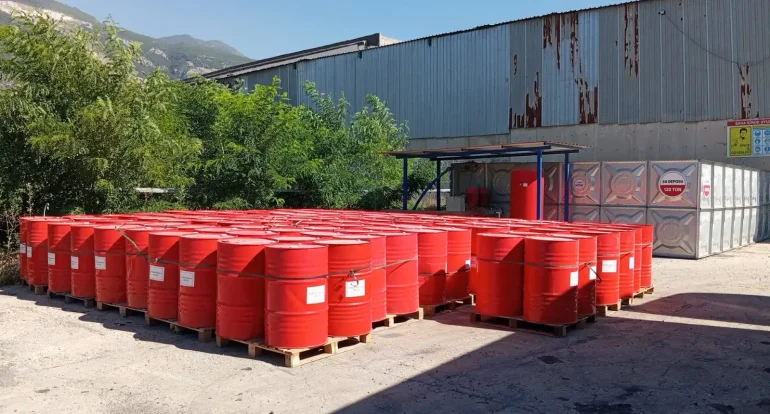
Raha Oil supplies cutback bitumen in steel drums and IBC tanks for flammable liquids. All shipments are packed, labelled and documented in line with dangerous goods transport regulations. Each shipment includes a Certificate of Analysis (COA), MSDS, packing list and Certificate of Origin. We export from Jebel Ali, Dubai, to the Middle East, Africa, and South and Southeast Asia. Contact our sales team (link → https://rahaoil.ae/contact/) for prices and loading details.
Frequently Asked Questions - FAQ
Cutback bitumen is penetration-grade bitumen dissolved in a petroleum solvent to make it fluid at low temperatures. After application, the solvent evaporates (cures) and the bitumen returns to its binding consistency. It is used for prime coats, tack coats, surface dressing, cold mix and dust control.
The difference is the solvent and the curing speed. RC (rapid curing) uses a highly volatile solvent such as naphtha and cures fastest. MC (medium curing) uses a kerosene-type solvent and cures more slowly. SC (slow curing) uses low-volatility oils and cures very slowly.
The number is the lower limit of the kinematic viscosity at 60 °C in mm²/s. Each grade covers a range from that value to twice that value. For example, RC-250 is 250–500 mm²/s. Lower numbers are more fluid; higher numbers are thicker and usually need heating.
Medium curing grades MC-30 and MC-70 are the standard choice for prime coats, because their kerosene-type solvent lets them penetrate porous granular bases before curing.
Rapid curing grades such as RC-70 and RC-250 are commonly used for tack coats, because they cure quickly and allow the next asphalt layer to be placed sooner. The final choice should follow your project specification.
Yes. All cutbacks contain petroleum solvents and must be kept away from heat, sparks and open flames. RC grades have the lowest flash points, followed by MC and then SC grades. Heavier grades should only be heated indirectly, never with an open flame.
Cutback bitumen is bitumen dissolved in a solvent, while bitumen emulsion is bitumen dispersed in water with an emulsifier. Cutbacks leave more bitumen on the surface and handle cool weather better. Emulsions release water instead of solvent, so they produce far lower emissions.
Raha Oil supplies cutback bitumen in steel drums and IBC tanks suitable for flammable liquids, shipped from Jebel Ali, Dubai, in line with dangerous goods regulations. Each shipment includes a COA, MSDS, packing list and Certificate of Origin.
| Grade | Kinematic Viscosity @ 60 °C (mm²/s) | Flash Point min (°C) | Curing Speed | Typical Uses |
|---|---|---|---|---|
| Rapid Curing (RC) · ASTM D2028 | ||||
| RC-30* | 30 – 60 | — | Fast | Very light spraying |
| RC-70 | 70 – 140 | — | Fast | Tack coat, light surface treatment |
| RC-250 | 250 – 500 | 27 | Fast | Tack coat, surface treatment, cold mix |
| RC-800 | 800 – 1600 | 27 | Fast | Surface dressing, plant-mixed cold mix |
| RC-3000 | 3000 – 6000 | 27 | Fast | Surface dressing with large chips |
| Medium Curing (MC) · ASTM D2027 | ||||
| MC-30 | 30 – 60 | 38 | Medium | Prime coat on dense bases |
| MC-70 | 70 – 140 | 38 | Medium | Prime coat on open bases |
| MC-250 | 250 – 500 | 66 | Medium | Cold mix, patching, stockpile mix |
| MC-800 | 800 – 1600 | 66 | Medium | Cold mix, surface dressing |
| MC-3000 | 3000 – 6000 | 66 | Medium | Surface dressing, heavy cold mix |
| Slow Curing (SC) · ASTM D2026 | ||||
| SC-70 | 70 – 140 | 66 | Slow | Dust control, soil stabilisation |
| SC-250 | 250 – 500 | 79 | Slow | Dust control, road mix |
| SC-800 | 800 – 1600 | 93 | Slow | Road mix, cold mix |
| SC-3000 | 3000 – 6000 | 107 | Slow | Road mix, cold mix |
Why Choose Raha Oil for Oxidized Bitumen
Raha Oil manufactures Oxidized Bitumen from Dubai, UAE, with production and testing following ASTM standards. Quality is verified through internal testing before every shipment, with full documentation — including TDS, COA, and MSDS — provided on request.
With flexible packing — from 20 kg Kraft bags to 200 kg steel drums, including palletized options — and an established export track record across the GCC, Africa, and Asia, Raha Oil supports both trial orders and large-scale industrial supply requirements for this specialized hard grade.
Get Oxidized Bitumen Export Quote
Looking for a reliable Oxidized Bitumen supplier in UAE?
RAHA Oil provides competitive FOB and CFR export prices for Blown Asphalt with worldwide shipment support from Jebel Ali ports.
- SGS Inspection Available
- Worldwide Export Support
Contact our export team today for updated prices and shipment schedules.


