
What is Rapid Curing Cutback Bitumen?
Rapid curing (RC) cutback bitumen is a liquid asphalt made by dissolving penetration grade bitumen in a highly volatile solvent, usually gasoline or naphtha. Because the solvent evaporates quickly after application, RC cutbacks set and harden faster than medium curing (MC) or slow curing (SC) grades, leaving a bitumen film that bonds well to the road surface.
RC cutbacks are produced in four standard grades under ASTM D2028 and AASHTO M81: RC-70, RC-250, RC-800 and RC-3000. The number shows the minimum kinematic viscosity at 60°C in centistokes (mm²/s). Lower numbers mean a more fluid product with a higher solvent content, while higher numbers mean a thicker product with more bitumen.
The quality of RC cutback is checked in two stages: tests on the cutback itself (viscosity, flash point and distillation) and tests on the bitumen residue left after distillation (penetration, ductility and solubility).
Uses and Applications of Rapid Curing Cutback Bitumen
Rapid curing cutback bitumen is used where a fast-setting liquid binder is needed and traffic must return to the road quickly. Because it can be sprayed or mixed with little or no heating, it is also practical in remote sites and for small maintenance jobs.
– Tack coat between an existing surface and a new asphalt layer
– Surface treatments such as chip seals and sand seals
– Road mix and cold premix for patching and pothole repair
– Sealing and bonding loose surface particles on old pavements
– Light waterproofing of surfaces and filling of capillary voids
Which RC Grade to Use?
– RC-70: the most fluid grade, used as a tack coat and for light spray applications.
– RC-250: the most widely used RC grade, suitable for tack coats, chip seals and road mix.
– RC-800: a thicker grade for surface treatments with larger aggregate and for premix.
– RC-3000: the most viscous grade, used for heavy surface treatments and seal coats.
Safety and Environmental Notes
RC cutbacks contain a highly volatile and flammable solvent, so they must be kept away from open flames and handled in well-ventilated areas. Because the solvent evaporates into the air, some countries restrict the use of cutbacks; in these cases bitumen emulsions are a common water-based alternative.
RC Cutback Bitumen — Technical Data Sheet
ASTM D2028 / AASHTO M81| Property | Test Method | RC-70 | RC-250 | RC-800 | RC-3000 |
|---|---|---|---|---|---|
| Kinematic Viscosity @ 60°C, mm²/s (cSt) | ASTM D2170 | 70–140 | 250–500 | 800–1600 | 3000–6000 |
| Flash Point (Tag Open Cup), °C, min | ASTM D3143 | – | 27 | 27 | 27 |
| Water, % volume, max | ASTM D95 | 0.2 | 0.2 | 0.2 | 0.2 |
| Distillation — % of total distillate to 360°C, min | |||||
| to 190°C | ASTM D402 | 10 | – | – | – |
| to 225°C | ASTM D402 | 50 | 35 | 15 | – |
| to 260°C | ASTM D402 | 70 | 60 | 45 | 25 |
| to 316°C | ASTM D402 | 85 | 80 | 75 | 70 |
| Residue from distillation to 360°C, % vol, min | ASTM D402 | 55 | 65 | 75 | 80 |
| Tests on Residue from Distillation | |||||
| Penetration @ 25°C, 100 g, 5 s, 0.1 mm | ASTM D5 | 80–120 | 80–120 | 80–120 | 80–120 |
| Ductility @ 25°C, 5 cm/min, cm, min | ASTM D113 | 100 | 100 | 100 | 100 |
| Solubility in Trichloroethylene, %, min | ASTM D2042 | 99 | 99 | 99 | 99 |
RC vs MC vs SC Cutback Bitumen: What is the Difference?
Cutback bitumens are divided into three types according to how fast their solvent evaporates. Rapid curing (RC) uses the most volatile solvent and sets fastest, medium curing (MC) uses kerosene and sets more slowly, and slow curing (SC) uses low-volatility oils and remains workable for the longest time.
RC vs MC vs SC Cutback Bitumen
Quick Comparison| Property | Rapid Curing (RC) | Medium Curing (MC) | Slow Curing (SC) |
|---|---|---|---|
| Solvent | Gasoline / naphtha | Kerosene | Low-volatility oils |
| Curing speed | Fast | Medium | Slow |
| Standard grades | RC-70 to RC-3000 | MC-30 to MC-3000 | SC-70 to SC-3000 |
| Flammability | Highest (lowest flash point) | Moderate | Lowest |
| Typical uses | Tack coat, chip seal, surface treatment | Prime coat, cold mix, stockpile patching | Dust control, road mix |
| Standard | ASTM D2028 | ASTM D2027 | ASTM D2026 |
Export Terms for RC Cutback Bitumen
Raha Oil exports RC cutback bitumen from the UAE to road contractors, government projects and trading companies across Africa, the GCC, South Asia and Southeast Asia.
Grades: RC-70, RC-250, RC-800, RC-3000
Loading Port: Jebel Ali (UAE)
Delivery Terms: FOB, CFR, CIF
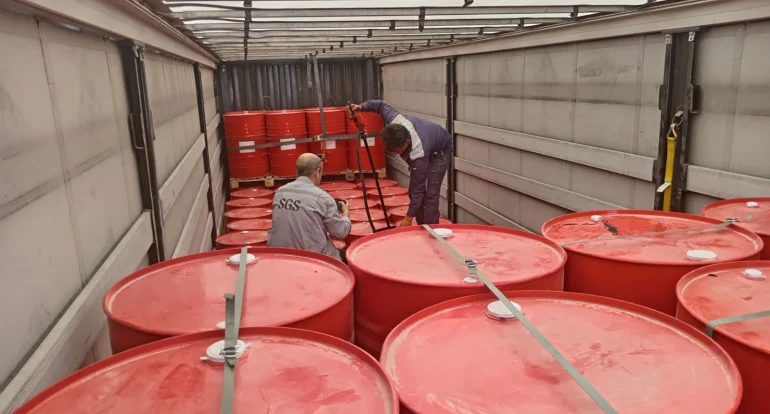
Packing: New or reconditioned 220 L steel drums (191 ± 3 kg net), IBC tanks, flexitanks
Dangerous Goods: shipped as Class 3 flammable liquid (UN 1999) with full DG documentation
Inspection: SGS or other third-party inspection at the loading port
Documents: COA, TDS, MSDS, Bill of Lading, Packing List, Certificate of Origin
Minimum Order: 1 x 20ft container
Why Buy RC Cutback Bitumen from Raha Oil?
Raha Oil supplies the full range of cutback bitumen, including rapid, medium and slow curing grades, as well as penetration grade bitumen and bitumen emulsions, so contractors can source all their road binders from one supplier and often in one shipment.
Every batch is tested against ASTM standards and shipped with a Certificate of Analysis. Our export team manages drum filling, dangerous goods documentation, container stuffing, customs clearance and vessel booking, and keeps buyers updated until delivery.
Frequently Asked Questions about RC Cutback Bitumen
Rapid curing (RC) cutback bitumen is penetration grade bitumen dissolved in a highly volatile solvent such as gasoline or naphtha. After application the solvent evaporates quickly, leaving a bitumen film that sets faster than medium or slow curing cutbacks.
The number is the minimum kinematic viscosity at 60°C in centistokes (mm²/s). Each grade has a range from that number to double it, for example RC-250 is 250–500 cSt. Higher numbers mean a thicker product with less solvent.
It is mainly used for tack coats, chip seals, sand seals and other surface treatments, as well as for road mix and cold premix patching, where a fast-setting binder is needed.
RC uses a highly volatile solvent (gasoline or naphtha) and sets quickly, while MC uses kerosene and sets more slowly. MC is usually preferred for prime coats because it penetrates deeper into granular bases, while RC is preferred for tack coats and surface treatments.
RC-250 is the most widely used grade because it works well for tack coats, chip seals and road mix. RC-70 is used for lighter spray work, while RC-800 and RC-3000 are used for heavier surface treatments.
Yes. RC cutbacks contain a volatile solvent with a low flash point, so they must be kept away from open flames and handled in well-ventilated areas. For export, they are shipped as Class 3 flammable liquids.
Raha Oil supplies RC cutback in new or reconditioned 220-litre steel drums with about 191 kg net weight, and in bulk using IBC tanks or flexitanks.
Yes. Every shipment comes with a Certificate of Analysis (COA), and third-party inspection by SGS or other agencies is available at the loading port.
Get RC Cutback Bitumen Export Quote
Looking for a reliable RC cutback bitumen supplier in UAE?
Raha Oil provides competitive FOB and CFR export prices for RC-70, RC-250, RC-800 and RC-3000 with worldwide shipment support from Jebel Ali and Mersin Port.
- New and Reconditioned Steel Drums (220 L)
- IBC Tank and Flexitank (Bulk)
- Dangerous Goods Documentation (Class 3)
- SGS Inspection Available
- Worldwide Export Support
Contact our export team today for updated prices and shipment schedules.


