
Description of Oxidized Bitumen 75/25
Oxidized Bitumen 75/25, also known as Blown Asphalt 75/25 or Oxidised Asphalt 75/25, is an air-blown industrial bitumen. It combines a moderate softening point with low penetration. It is made by passing controlled amounts of air through hot, soft penetration-grade bitumen until the target specification is reached. During blowing, part of the oily fraction of the bitumen is converted into heavier asphaltenes, which gives the product its firm, gel-like structure.
The result is a bitumen that is hard and resistant to indentation at ambient temperature, yet melts at a lower temperature than high-softening grades. This combination makes 75/25 well suited to coatings, mastics, sealants and compounds that must be firm in service but easy to melt and process.
Understanding the 75/25 Grade
As with all oxidized grades, the two numbers are the midpoints of the main specifications:
75 is the midpoint of the softening point range, 70–80 °C (Ring and Ball, ASTM D36).
25 is the midpoint of the penetration range, 20–30, in units of 0.1 mm at 25 °C (ASTM D5).
75/25 shares its softening point range with Oxidized Bitumen 75/35 , but its lower penetration makes it harder and more resistant to creep. It shares its penetration range with Oxidized Bitumen 85/25, but it softens about 10 °C earlier, which makes it easier to melt and process.
Like other air-blown grades, 75/25 has a high penetration index (PI), so its consistency is far less sensitive to temperature than that of road-paving bitumen.
Oxidized Bitumen 75/25 from Raha Oil
Raha Oil supplies Oxidized Bitumen 75/25 from Jebel Ali, Dubai, to manufacturers of coatings, mastics and waterproofing products, as well as contractors and traders across the Middle East, Africa, and South and Southeast Asia. Each batch is tested against the technical data sheet below and shipped with a Certificate of Analysis (COA), MSDS, packing list and Certificate of Origin. For a quotation, contact our sales team .
Applications of Oxidized Bitumen 75/25
Protective coatings and bituminous paints: anti-corrosion coatings for steel structures, tanks and pipes, and protective paints for concrete.
Mastics and sealants: a base binder for bituminous mastics, joint sealants and crack fillers used in construction and civil works.
Pipe wrapping and coating compounds: hot-applied protective layers for buried pipelines, often combined with reinforcement tapes.
Waterproofing: damp-proofing of foundations, basements and retaining walls, and production of waterproofing compounds.
Roofing: coating and bonding of roofing felts and membranes in moderate climates.
Adhesives and insulation: bonding insulation boards and floor coverings.
Automotive and acoustic products: underbody coatings and sound-damping pads.
Electrical compounds: filling and sealing compounds for cable joints and junction boxes.
Climate note: with a softening point of 70–80 °C, 75/25 is best suited to covered, below-ground or moderate-climate applications. For exposed surfaces in very hot regions, a higher-softening grade such as Oxidized Bitumen 90/15 or Oxidized Bitumen 105/15 is generally recommended.
How to Apply Oxidized Bitumen 75/25
Melt the material gradually in a suitable kettle until it reaches a fluid, workable consistency, staying below the maximum temperature given in the handling section. Surfaces should be dry, clean and free of dust, oil, rust scale and loose material. On concrete and masonry, priming with Bitumen Primer D41 helps the hot bitumen bond properly.
Properties and Advantages of Blown Asphalt 75/25
Firm and creep-resistant: low penetration (20–30) gives good resistance to indentation and deformation.
Easier processing: a softening point of 70–80 °C allows lower melting temperatures than high-softening grades.
Low temperature susceptibility: a high penetration index keeps its properties stable over a wide temperature range.
Waterproof: forms a dense, impermeable protective layer.
Strong adhesion: bonds well to steel, concrete, felts and insulation materials.
Corrosion and chemical resistance: protects metal and resists water, salts, and dilute acids and alkalis.
Thermally stable: loss on heating of 0.2 wt% max.
Comparing grades? See Oxidized Bitumen 75/35 for a more flexible option, or Oxidized Bitumen 85/25 for higher heat resistance. You can also view the full range on our Oxidized Bitumen page.
Storage and Handling of Oxidized Bitumen 75/25
Storage recommendations:
Store Oxidized Bitumen 75/25 indoors, in a dry, shaded and ventilated area. Protect it from rain, direct sunlight and heat sources.
Keep bags, cartons and drums on pallets. With a softening point of 70–80 °C, this grade can soften in very hot warehouses, so limit stack heights in summer to prevent deformation and sticking.
Keep the product in its original, closed packing until use to avoid moisture and contamination. When it is stored correctly and kept away from heat, its properties remain stable during normal storage periods.
Melting and heating:
Bitumen is a poor heat conductor, so heating must be controlled to protect both workers and product quality.
Break the material into smaller pieces before charging the kettle, so it heats evenly without local overheating.
Raise the temperature gradually and never exceed 230 °C. Because 75/25 melts at a lower temperature than high-softening grades, it can usually be worked well below this limit. Overheating risks thermal cracking and the release of flammable vapours.
Do not let melted bitumen solidify in the kettle and then reheat it from cold. Hot spots and trapped pressurised vapour can form.
Place temperature probes close to the heat source for accurate control.
Keep water away from hot bitumen to prevent foaming and boil-over.
Avoid long or repeated heating, which hardens the bitumen and can take it outside its specification.
Health and Safety
Protective equipment: wear heat-resistant gloves, safety goggles or a face shield, long-sleeved protective clothing and safety boots when handling hot material.
Ventilation: use in well-ventilated areas and avoid breathing fumes. Hot bitumen may release hydrogen sulphide (H₂S), especially in tanks and confined spaces.
Burns: cool any skin burn from hot bitumen under cold running water for at least 15 minutes. Do not peel the bitumen off. Seek medical attention.
Cleaning: clean tools and equipment with an approved industrial bitumen cleaner, away from heat and flames. Never use gasoline (petrol).
Fire: extinguish with foam, dry chemical powder or CO₂. Do not direct water jets at hot or burning bitumen.
The MSDS for Oxidized Bitumen 75/25 is available on request from our sales team .
Packing and Delivery of Oxidized Bitumen 75/25
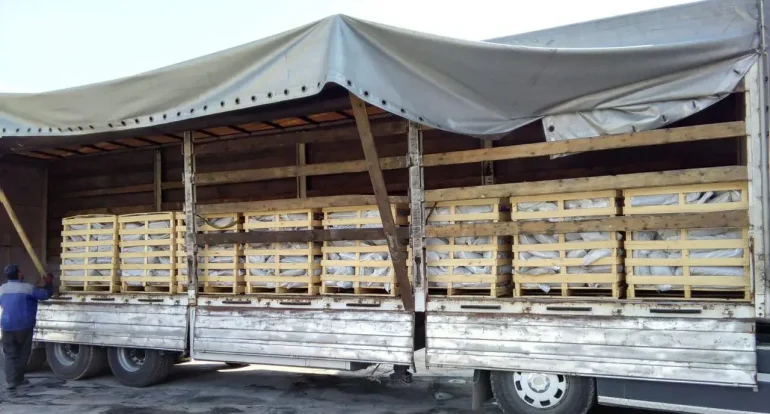
Raha Oil delivers Oxidized Bitumen 75/25 in four export packing options. Each one suits a different melting setup, destination climate and storage period. Bags can be palletised, with 40 bags per pallet, or loaded loose into 20ft containers.
Kraft Paper Bags – 20 kg and 50 kg
Multi-layer Kraft paper bags with an anti-stick silicone lining. This is the most economical and widely used option for oxidized bitumen. The paper is removed before the bitumen is melted.
Polyamide Bags – 20 kg and 50 kg
Heat-resistant polyamide bags are filled hot and cooled rapidly in water. The strong film protects the bitumen from moisture and dust and stops the bags from sticking together during transport.
Carton Boxes – 25 kg
Bitumen is cast into lined carton moulds and solidifies into uniform blocks. Cartons stack neatly, hold their shape in warm conditions and are simple to handle and count on site. This premium option is a good choice for hotter destinations.
Steel Drums – 150 kg, 180 kg and 200 kg
Sealed steel drums give maximum protection against heat deformation, moisture and contamination. They are recommended for long sea voyages, hot climates and long storage periods. The number of drums per container depends on the drum size.
For more information, see our bitumen packaging page or contact our sales team to agree the right packing and loading plan for your order.
Frequently Asked Questions - FAQ
Oxidized Bitumen 75/25, also known as Blown Asphalt 75/25, is an air-blown industrial bitumen with a softening point of 70–80 °C and a penetration of 20–30. It is firm and creep-resistant at ambient temperature but melts more easily than high-softening grades, which makes it ideal for coatings, mastics and sealants.
75 is the midpoint of the softening point range (70–80 °C, ASTM D36), and 25 is the midpoint of the penetration range (20–30 × 0.1 mm at 25 °C, ASTM D5).
It is used in anti-corrosion coatings and bituminous paints, mastics, joint sealants and crack fillers, pipe wrapping compounds, damp-proofing of foundations, roofing felts in moderate climates, insulation adhesives, automotive sound-damping products and electrical cable joint compounds.
Both grades have the same softening point range (70–80 °C). 75/25 has lower penetration (20–30), so it is harder and more resistant to creep and indentation. 75/35 (30–40) is softer and more flexible, especially in cool weather.
Both have the same penetration range (20–30), but 85/25 has a softening point about 10 °C higher (80–90 °C). 75/25 is easier to melt and process, while 85/25 offers more heat resistance for exposed or hot-climate applications.
No. Oxidized bitumen is made for industrial, coating and waterproofing uses, not for asphalt road mixes. Road paving uses penetration-grade bitumen such as Bitumen 60/70.
Raha Oil supplies 75/25 in 20 kg and 50 kg Kraft paper bags, 20 kg and 50 kg polyamide bags, 25 kg carton boxes, and 150 kg, 180 kg and 200 kg steel drums. Bags can be palletised (40 bags per pallet) or loaded loose in 20ft containers.
Every shipment from Jebel Ali, Dubai, includes a Certificate of Analysis (COA), Material Safety Data Sheet (MSDS), packing list and Certificate of Origin. Other documents can be arranged on request.
| Property | Test Method | Unit | Specification |
|---|---|---|---|
| Specific Gravity @ 25/25 °C | ASTM D70 | — | 1.05 approx. |
| Penetration @ 25 °C100 g, 5 s | ASTM D5 | 0.1 mm | 20 – 30 |
| Softening PointRing & Ball | ASTM D36 | °C | 70 – 80 |
| Loss on Heating | ASTM D6 | wt % | 0.2 max |
| Flash PointCleveland Open Cup | ASTM D92 | °C | 250 min |
| Solubility in CS2 | ASTM D4 | wt % | 99.5 min |
| Spot Test | AASHTO T102 | — | Negative |
Why Choose Raha Oil for Oxidized Bitumen 75/25
Raha Oil manufactures Oxidized Bitumen 75/25 from Dubai, UAE, with production and testing following ASTM standards. Quality is verified through internal testing before every shipment, with full documentation — including TDS, COA, and MSDS — provided on request.
With flexible packing — from 20 kg Kraft bags to 200 kg steel drums, including palletized options — and an established export track record across the GCC, Africa, and Asia, Raha Oil supports both trial orders and large-scale industrial supply requirements for this specialized hard grade.
Get Oxidized Bitumen Export Quote
Looking for a reliable Oxidized Bitumen supplier in UAE?
RAHA Oil provides competitive FOB and CFR export prices for Blown Asphalt with worldwide shipment support from Jebel Ali ports.
- SGS Inspection Available
- Worldwide Export Support
Contact our export team today for updated prices and shipment schedules.


